 Dream Decoder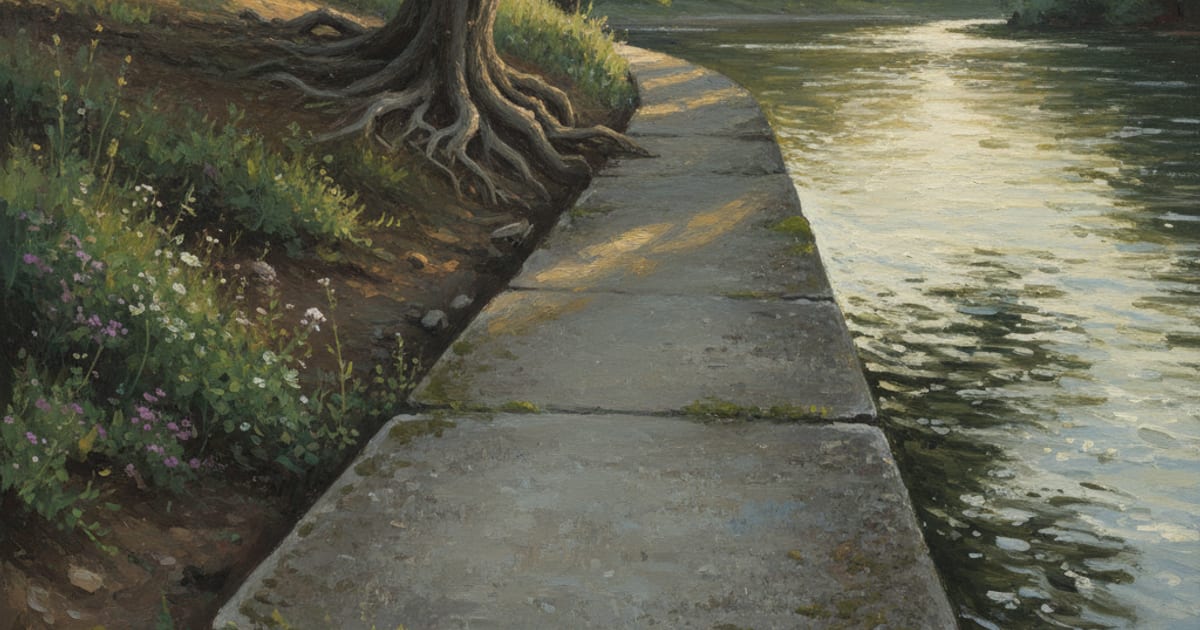
Dreams are fascinating visitors, aren't they? Sometimes they arrive cloaked in mystery, leaving us pondering their enigmatic symbols. Other times, they replay our deepest anxieties, holding up a lamp to the unspoken fears that reside within. But then there are those rare and profound moments when a dream presents us with a landscape so vividly structured, so rich in contrast, that it feels less like a narrative and more like an invitation – an invitation to sit, observe, and unravel the intricate tapestry of our inner world.
Imagine finding yourself positioned at such a junction: settled upon a solid, man-made surface, perhaps a cool, unyielding concrete slab, right at the precipice where it meets the wild, untamed flow of a river. This isn't just a physical location; it's a profound metaphor for the places we often find ourselves in life – straddling the engineered and the organic, the planned and the spontaneous, the known and the unknowable. This dream image, so striking in its simplicity, speaks volumes about the delicate balance we constantly seek between structure and current, between the world we meticulously build and the natural forces that shape us.
From this unique vantage point, an observer might cast their gaze first upon the river. The river, that timeless symbol of life's relentless flow, of emotion's deep currents, and the ever-present march of change. It moves with a quiet power, an unending journey from source to sea, mirroring the continuous unfolding of our own existence. To watch it is to contemplate the ceaseless transformation within and around us – the joys that flow in, the sorrows that drift away, and the subtle shifts in our own emotional landscapes. Are we carried by its current, or do we stand firm against it, striving to maintain a sense of control? The dreaming mind often places us at such observational posts precisely so we might ponder these fundamental questions.
Yet, the scene is not solely dominated by the river's grand narrative. Our focus might be drawn closer, to the very bank where the concrete meets the soil. Here, life finds its foothold in remarkable ways. A tree, perhaps, stands sentinel, its trunk a testament to enduring growth, its branches reaching skyward. But it's the hidden strength that truly captivates: the roots. These subterranean anchors, often unseen, delve deep into the earth, intertwining with soil and dirt, drawing sustenance from the very ground that supports all life. They speak to our own foundations, to the hidden strengths and connections that ground us, even when our conscious minds are preoccupied with the surface world. What unseen forces nourish our growth? What deep-seated connections keep us upright amidst life's storms?
This interplay between the visible and the veiled becomes even more compelling with the introduction of subtle, almost secretive details. Tiny flashes of red might catch the eye, perhaps half-obscured, adding a burst of vital energy or a spark of passion to the scene. And then there's the possibility of hidden graffiti, tucked away behind shrubs, offering fleeting glimpses of human expression that defies the conventional. These aren't overt declarations, but rather whispered messages, hinting at creative impulses, forgotten stories, or perhaps even rebellious spirits that thrive beneath the surface of the established order. They invite us to look closer, to question what we might be missing in our hurried daily lives, to appreciate the beauty and truth found in the overlooked corners of our experience.
The juxtaposition is everywhere: the solid concrete versus the flowing water, the visible tree versus its hidden roots, the wild shrubs versus the intentional markings of human hand. The dream becomes a powerful stage upon which our subconscious processes the contrasts of our reality. Are we feeling firmly planted but yearn for more movement? Are we overwhelmed by change and seeking a solid platform? The very act of observation, of curiosity, points to an innate desire to understand these forces within ourselves and in the world around us. It's a journey not just into external landscapes, but into the interior hills and valleys of our own psyche.
This is the magic of the dreaming mind: it doesn't just show us things; it places us within a living tableau that reflects our current state, our unresolved questions, and our budding insights. The interplay of boundaries and flow, of natural resilience and human imprint, suggests a rich inner dialogue about adaptation, connection, and authenticity. It asks us to consider where we find our groundedness – in external structures or in the deep roots of our being. It prompts us to notice the hidden messages, the 'tiny red' flashes of insight, and the quiet acts of creation that often go unacknowledged.
Ultimately, such a dream experience is a profound meditation on balance. It's about finding harmony between the practicalities of our waking world and the wild, intuitive wisdom of our spirit. It encourages us to sit with the paradoxes, to observe without judgment, and to trust that even in the most contrasting environments, there are profound truths awaiting discovery. Whether those truths manifest as psychological insights into our coping mechanisms or as mystical messages guiding our spiritual path, the act of engagement with these dream landscapes is a step towards deeper self-understanding.
So, the next time your dreams place you at such a poignant confluence, take a moment to truly sit within that scene. Observe the river's flow, feel the solidity beneath you, and search for the hidden glimpses of truth. For it is in these liminal spaces, where the structured meets the wild, that we often find the clearest reflections of our truest selves and the wisest guidance for our journey forward. What hidden messages are waiting for you at the river's edge?