 Dream Decoder
Halloween sells us ghosts, zombies and figures in the dark. The frightening dreams people actually write down tell a quieter story.
We looked at every dream logged in Dream Decoder since 2024: 6,911 dreams from 2,556 people. 907 of them, about one in eight, were frightening, either tagged as a nightmare or carrying fear, terror, horror or panic. Nearly one in four people who use the app (579 of 2,556) has logged at least one.
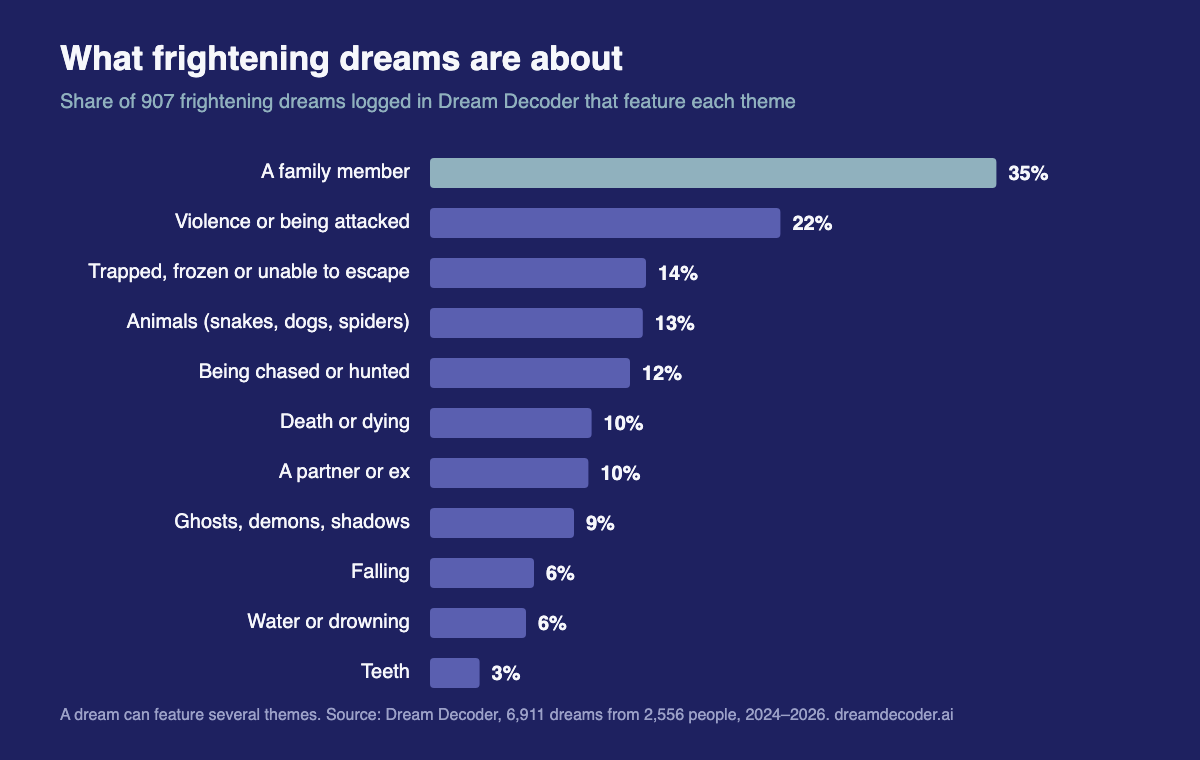
The figure in the dark is usually someone we love
A family member appears in 35% of frightening dreams. Across all dreams it's 13%, so family shows up almost three times as often when a dream turns bad. Mothers, siblings and children each appear in about one in ten. Strangers and unknown figures, the classic horror villain, appear in 15%.
Dream researchers would not be surprised. The continuity hypothesis holds that dreams recycle what occupies us while awake, and few things occupy us more than the people we are responsible for. A dream about a mother in danger or a child who goes missing is rarely about the event itself. It tends to track worry, guilt or a sense of not being able to protect someone.
What else keeps us up
- Violence or being attacked: 22% (what it means)
- Being trapped, frozen or unable to escape: 14% (can't run)
- Animals (snakes, dogs, spiders): 13%
- Being chased or hunted: 12% (being chased)
- Death or dying: 10%
- A partner or ex (cheating, leaving): 10%
- Ghosts, demons and shadows: 9% (shadow figures)
- Falling: 6%, water or drowning: 6%, and the famous teeth falling out: only 3%
The supernatural, the stuff of Halloween, sits in the bottom half. Being frozen and unable to get away is more common than any ghost. That feeling has a physical side: during REM sleep the body's muscles are switched off, and some researchers think that is why "my legs wouldn't move" is such a common nightmare. When you wake inside that state, it's sleep paralysis.
Fear, then helplessness
Fear is attached to 90% of these dreams and anxiety to 48%. The third most common emotion is telling: helplessness, in more than one in five.
They come back
Almost a quarter of the people who logged a frightening dream (139 of 579) logged more than one. Recurring nightmares are where a technique called imagery rehearsal comes in. It's used by sleep clinicians: you write the nightmare down, give it a new, safer ending, and rehearse that ending while awake. Dream Decoder has a guided version built in, and for Halloween week (24 October to 2 November) we're running Nightmare Rewrite Week: seven nights, one rewritten nightmare at a time. Start with your own dream.
If a nightmare follows something that really happened to you, or nightmares are affecting your sleep or health, talk to someone you trust or a doctor. Nightmares are common, and help is available.
How we counted
A dream counts as frightening if it was tagged as a nightmare or its recorded emotions include fear, terror, horror, panic, dread or fright. Themes and figures come from the keywords and people our AI extracts from each dream, grouped by us; a dream can fall into several themes. The data comes from people who chose to keep a dream journal, most of them writing in English, so it describes our users rather than everyone. All figures are aggregates; no individual dream was read or published for this piece. The chart is free to use with credit to Dream Decoder.