 Dream Decoder
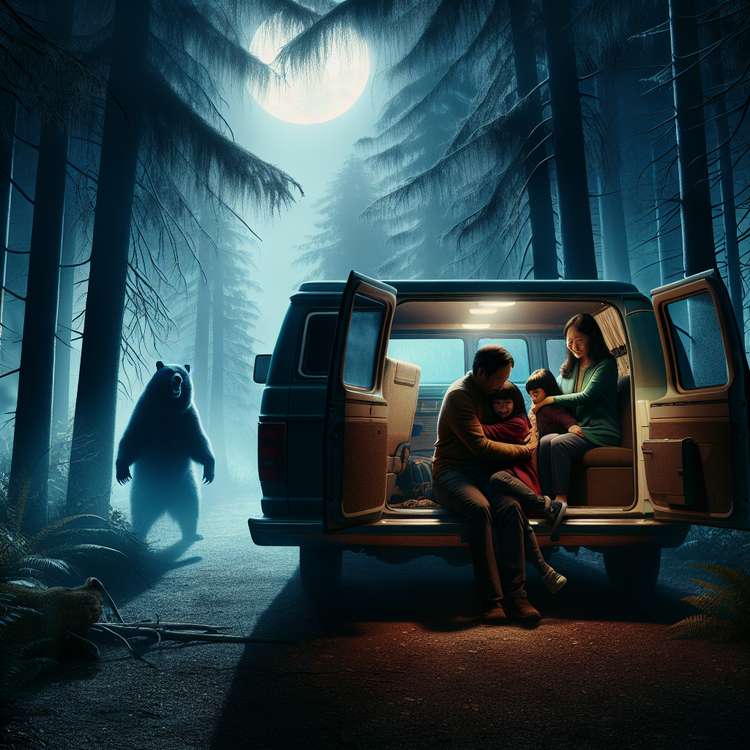
A nightmare about a bear in a dark forest often points to a threat you can sense but cannot yet judge or control. The bear may stand for a demanding situation, while the dark forest makes the next move feel uncertain. The most useful clue is whether you feared the bear itself, feared getting lost, or felt responsible for someone else.
What happened in the dream, and what matters?
One dreamer described stopping a van beside a forest at night after a family member spotted movement among the trees. A bear appeared, and the dreamer stood outside holding the keys, torn between approaching it and getting everyone away. Their parents and sister were in the van; eventually, the dreamer got back in and drove off.
The bear never had to attack for the scene to feel dangerous. Much of the tension came from waiting, deciding, and trying to keep other people safe with limited information. If that sounds like your dream, focus less on what bears mean in general and more on the choice you faced: move toward the unknown, stay still, or leave.
The van matters because it offered a way out, but using it meant making a decision for the group. The forest mattered because the dreamer could not see far enough ahead to know whether leaving, waiting, or investigating was safest. Those details may fit a week in which you have options but do not feel sure which one protects what matters to you.
What does a bear in a dark forest usually mean?
A problem you know is there but cannot size up
If you are approaching a deadline, awaiting test results, or expecting a difficult conversation, the bear may reflect a concern that feels bigger because its outcome is unknown. The darkness adds uncertainty: you cannot tell whether the problem is close, whether it will escalate, or whether you have enough time to respond. Ask whether the fear in the dream resembles anticipation more than an immediate crisis.
Feeling responsible for other people
If you are caring for a parent, managing a household move, or helping a sibling through a hard week, the family in the van may make this a dream about responsibility. You might feel you must investigate the danger while also being the one who gets everyone to safety. The bear is then less a stand-in for one person than a reminder of how much feels at stake when others rely on you.
A choice between caution and confrontation
If you have been avoiding a conflict at work or putting off a breakup conversation, walking toward the bear may echo the urge to face something directly. Getting back in the van may instead express a wish for distance, rest, or a safer time to act. Neither ending proves what you should do when awake; notice which part of the choice brought relief and which part left you uneasy.
Which details change the meaning?
- The bear stays at the forest edge: A threat that remains at a distance can fit a worry about what might happen, such as a pending decision or an unanswered message. If it moves toward you, the pressure may feel more immediate.
- You are lost among the trees: Without the van or a visible route, the dream may be less about protecting others and more about not knowing where to begin. This can fit the first days of a new job, a move, or another unfamiliar situation.
- Family waits in the van: Their presence can shift the question from “Am I safe?” to “Can I keep us safe?” If you are alone instead, pay attention to whether solitude feels freeing or frightening.
- You drive away: Leaving can feel like a successful escape or an unfinished task. The emotion after you leave is more revealing than the action itself: relief and regret point toward different concerns.
- You feel curious rather than terrified: A bear watched from a distance may represent something powerful you want to understand, not only something you fear. Curiosity can suggest you feel ready to look more closely at an uncertain situation.
What do other dreamers report?
In dreams recorded in Dream Decoder, “dark” appears in 33 dreams. Among those dreams, people tagged fear at 76%, helplessness at 30%, and anxiety at 27%; 55% were nightmares. Those figures suggest darkness often accompanies distress in this collection, though the tags do not tell us what caused any individual dream.
“Forest” appears in 41 dreams recorded in Dream Decoder. Curiosity was tagged at 34%, fear at 29%, anxiety at 17%, and wonder at 15%; 20% were nightmares. That mix is a useful reminder that the forest can feel inviting as well as threatening, even when your forest was dark.
The app figures describe recorded dreams, not the odds that your dream means any particular thing. Compare the contrast between darkness and forest with your own experience: did the setting itself frighten you, or did fear begin when you noticed the bear? For a broader look at those symbols, see bear dreams and forest dreams.
What questions should you ask yourself?
- What happened this week that feels hard to assess from a distance: a deadline, a conversation, a decision, or news you are waiting for?
- When you saw the bear, were you most afraid of being hurt, making the wrong move, or failing to protect someone in the van?
- Did anyone recently look to you to take charge, even though you did not have enough information to feel confident?
- What did the van offer you in the dream: a real way to leave, a place to be with family, or a responsibility you could not set down?
- When the dream ended, did driving away feel like safety or like postponing something you still need to face?
What can you do after this nightmare?
Write down the scene soon after waking, along with the strongest feeling and the moment it changed. A short note such as “I saw the bear, then worried about my sister” is more useful for reflection than trying to decode every object at once. If one detail keeps catching your attention, include it even if it seems ordinary.
Look back at the day before the dream. Did you hear troubling news, take on an extra responsibility, watch something tense, or go to bed with a decision unresolved? A connection does not have to be exact; noticing what was fresh in your mind can help you distinguish a current worry from a general fear.
If the same nightmare recurs, try rewriting its ending while awake. You might imagine returning to the van, telling everyone what you saw, and choosing a clear route away; then spend a little time picturing that version. This approach is often called imagery rehearsal: the aim is not to prove what the bear means, but to give yourself a less frightening way to finish the scene.