 Dream Decoder
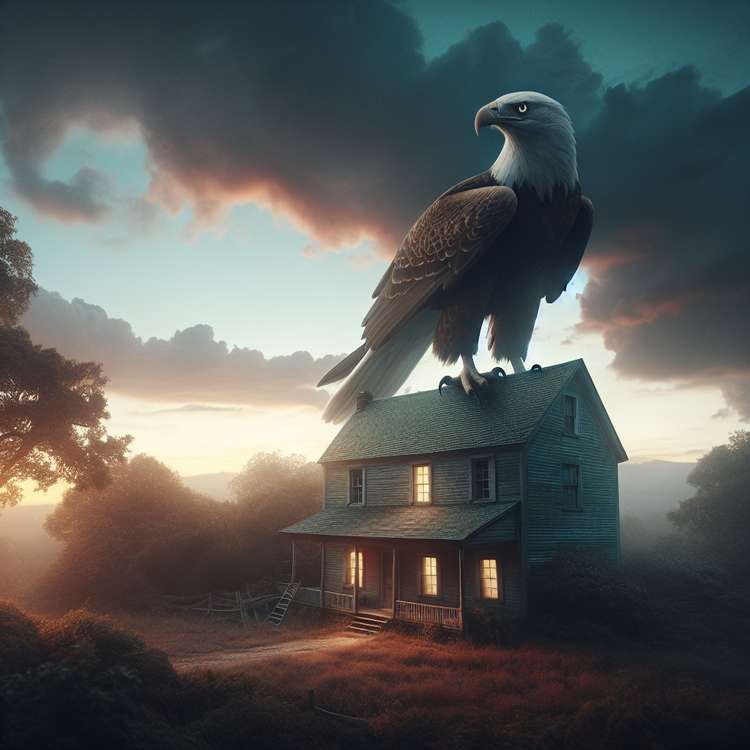
A giant bird near a house often points to something powerful or unfamiliar entering a part of life that usually feels settled. The house may represent home, family, or your sense of safety; the bird’s size suggests that whatever has your attention feels hard to ignore. The clearest clue is whether you wanted to approach it, protect the house, or get away.
What happened in the dream?
One dreamer described standing outside a familiar house when an enormous bird landed on the roof and watched them. It shifted a roof tile, something small fell to the path, and then the bird circled overhead before disappearing into a cloud.
What matters is the bird’s position: it arrives above the house rather than inside it. The dreamer can see the disturbance but has a moment to decide whether to move closer. The fallen object could also matter if it felt significant on waking; if not, the stronger image may simply be a huge visitor briefly changing a familiar place.
Notice, too, that the bird leaves without destroying the house. A dream can feel threatening even when nothing terrible happens. If that matches your experience, ask whether the fear came from what the bird did or from what you expected it might do.
What does a giant bird at a house usually mean?
A big change is approaching home
A move, a new housemate, or a change in family responsibilities can make an ordinary home feel less predictable. In that situation, the giant bird may stand for the size of the change, while the house marks what you want to keep stable. If the bird stayed outside, you may be watching a change approach rather than dealing with its full effects yet.
This reading fits especially well when the dream felt watchful rather than panicked. You might be curious about what comes next and still wish you had more control over when it arrives. Neither feeling cancels out the other.
An obligation feels bigger than your available space
A deadline, a difficult decision at work, or caring for a parent can follow you home in your thoughts. The bird on the roof may reflect how visible that obligation feels, even during time you would rather spend resting. If you were worried about the roof or door, consider whether you have been thinking about what this demand could cost you in time or energy.
The dream does not tell you whether the obligation is dangerous. It gives you a way to name its scale: something that may be manageable in daylight can still feel enormous when you are tired or waiting for news.
You are drawn toward an unfamiliar possibility
A giant bird can inspire wonder as well as fear. If you hoped it would lead you somewhere, the dream may fit a job opportunity, a creative project, or a relationship that could change your routine. The house then becomes the familiar place you would have to step away from, at least a little, to explore it.
Pay attention to whether you actually followed the bird. Wanting to go but remaining on the porch may echo a real choice you have not made. If it flew away and you felt relieved, you may value the possibility more at a distance than as an immediate commitment.
How do the details change the meaning?
- It lands on your childhood home: Family memories or an old version of yourself may be more relevant than your current living situation. Think about what that home meant to you, not what houses are supposed to mean in general.
- It appears at your current home: A recent disruption to your routine may be the closer match. Consider visitors, repairs, changing schedules, or a conversation that made home feel different this week.
- Someone is beside you: Their reaction may tell you more than the bird does. If they welcome it while you hide, the dream could reflect a difference in how you both view an upcoming decision.
- The bird enters through a door or window: The issue may feel immediate rather than distant. Ask what has crossed into your private time lately, especially if you tried to shut the opening.
- It flies away and leaves the house intact: Relief, disappointment, or curiosity at its departure can distinguish a feared interruption from a missed opportunity. The ending matters more than the bird’s size alone.
- You feel wonder instead of fear: The same enormous bird can point toward possibility rather than threat. An intense feeling does not automatically mean something bad is coming.
What do dreamers report?
In dreams recorded in Dream Decoder, bird dreams appear in 22 dreams. The emotions most often tagged are joy (27%), wonder (23%), fear (18%), and curiosity (18%). Birds appear alongside a house in 3 dreams and flight in 3 dreams; 9% of the bird dreams were nightmares. Those figures suggest that a bird can be striking without being frightening.
House dreams appear in 127 dreams recorded in Dream Decoder. Their most-tagged emotions are anxiety (34%), fear (32%), confusion (17%), and frustration (12%); 9% were nightmares. Houses appear with mother in 11 dreams, family in 10, friend in 9, water in 6, and door in 5. The house may bring everyday relationships and worries into the scene, even when the bird gets most of your attention.
These are reports from people using the app, not a rule for interpreting your dream. The contrast between the bird’s varied emotions and the house’s more uneasy ones is a useful prompt: which part of the scene actually troubled you?
What should you ask yourself?
- What happened this week that felt unusually large: a deadline, a decision, unexpected news, or someone else’s need?
- Did the house resemble a place you live now, somewhere you used to live, or no real place? What is on your mind about that place?
- Were you afraid of the bird itself, or of what it might do to the house or the people inside?
- When the bird moved or left, did you feel relief, regret, curiosity, or something else? Does that feeling resemble your reaction to a current possibility?
- Is there a small detail you keep remembering, such as the roof tile, a sound, or a doorway? Did anything from the previous day bring it to mind?
What can you do with this dream?
Write down the scene while you still remember it, along with the strongest feeling at each point. A brief note such as “worried when it landed, curious when it flew away” is more useful than forcing a single meaning onto the whole dream.
Then note what happened the day before, including conversations, changes at home, and anything you were anticipating. If a connection seems plausible, use it as a question to reflect on—not proof that the dream predicts an outcome. You can return to your notes later and see whether the same setting or feeling comes up again.
If this becomes a recurring nightmare, try rewriting its ending while awake. You might imagine the bird settling safely nearby, the house staying secure, or yourself choosing where to stand. Rehearsing a less frightening version gives you a concrete way to engage with the image rather than only bracing for its return.